
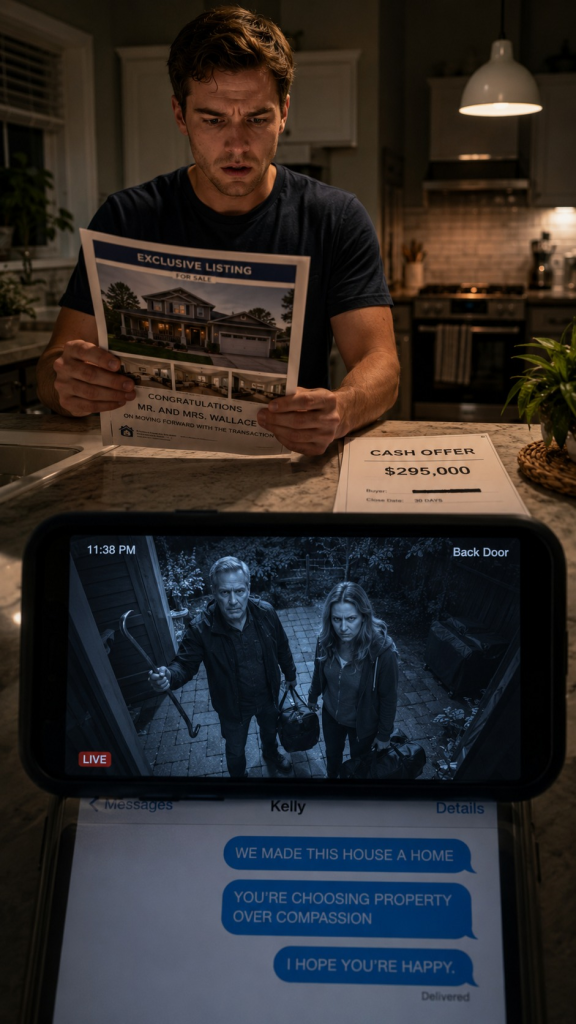
I found out my fiancée had listed my house for sale while I was standing barefoot in my own kitchen at 11:42 on a Tuesday night, staring at a packet from a real estate agency I had never contacted and photographs of rooms I had painted with my own hands.
For a few seconds, I did not understand what I was seeing.
That sounds ridiculous now, because the packet was not subtle. It had the agency logo across the top. It had a proposed listing price. It had a tentative closing date circled in blue. It had a buyer’s name, a cash offer, and a neat little paragraph congratulating “the sellers” on moving forward with such an exciting transaction. But when something impossible appears in front of you, your mind does not accept it right away. It tries to put the world back together in some less terrifying order.
Maybe it was a scam. Maybe it was junk mail dressed up to look official. Maybe some confused agent had mixed up addresses. Maybe someone had used a stock photo that looked like my living room.
Then I turned the page.
There was my couch.
There was the bookshelf Kelly had insisted we organize by color because “it looked cleaner that way,” even though I hated not being able to find anything. There was the kitchen island with the tiny burn mark I had made the first month I moved in when I set a hot pan down without thinking. There was the bedroom window with the dark blue curtains I had bought on clearance after closing because I had spent every dollar I had on the down payment and still needed privacy. There was my backyard, my fence, my garage, my house.
My house.
Not ours. Not hers. Mine.
I stood there with the packet in both hands, feeling the floor under my feet like it might shift.
A person can think he knows what betrayal feels like. I had imagined betrayal as something loud and obvious. A fight. A confession. A text message found at midnight. A lie cracked open in the middle of dinner. I did not expect it to arrive in clean white paper, with professional formatting and a polite message from a real estate agency thanking me for my cooperation.
I read the first page again.
Dear Mr. and Mrs. Wallace,
We are pleased to confirm the updated timeline for the sale of 1846 Ridgemont Lane…
Mr. and Mrs. Wallace.
I was not married. Kelly and I were engaged, wedding planned for the following June, deposits paid, guest list half-finished, arguments about centerpieces still unresolved. She had moved into my house after we had been dating for about a year, but her name had never been on the deed, the mortgage, the insurance, or even the property tax account. She did not contribute to the down payment because I had bought the house before I met her. She did not contribute to the mortgage because I had told her that splitting utilities, groceries, and household expenses was enough.
I had thought I was being generous.
No, that is not honest.
I had thought I was building a life with someone.
Those are not always the same thing.
The house had never been fancy. Three bedrooms, one and a half bathrooms, a backyard big enough for a grill and a tired little maple tree, and a detached garage that leaned slightly to the left if you stared at it too long. It sat in a working neighborhood outside Columbus, Ohio, where people mowed their own lawns, shoveled their own driveways, and pretended not to notice when someone’s trash cans stayed at the curb too long. It was not a dream home if your dreams had marble counters and vaulted ceilings. But when I bought it at twenty-nine, it felt like winning a war.
I grew up in apartments where the heat was unreliable and the neighbors changed every six months. My mother raised me and my younger sister by herself after my father left. She worked in a medical billing office during the day and cleaned offices at night when things got tight. We never starved, but we learned early that wanting something and needing something were two different categories, and most things belonged in neither because there was no money for them anyway.
When I got my first decent job as a logistics coordinator, I started saving like a man digging a tunnel. No vacations. No new car. No expensive clothes. No weekends out unless someone else was paying. I worked overtime whenever they offered it. I ate instant ramen, canned soup, discount chicken, peanut butter sandwiches, and enough store-brand cereal to qualify as a public health concern. I watched friends take trips, buy motorcycles, upgrade apartments, and complain about brunch prices while I quietly transferred money into a savings account every Friday.
Five years later, I had the down payment.
When the realtor handed me the keys, I stood alone in the empty living room and cried. Not dramatic movie tears. Just this embarrassing quiet leak of exhaustion and disbelief. I touched the wall like the house might disappear if I did not confirm it was solid. I remember thinking, No one can take this from me.
That sentence aged poorly.
Kelly came into my life three years after I bought the house.
She was twenty-nine, bright, warm, funny, and the kind of woman who could make a grocery store checkout line feel like a party. I met her at a friend’s barbecue where she arrived late with two pies, a bottle of wine, and an apology so charming that everyone forgave her before she finished the sentence. She had curly brown hair, quick eyes, and a laugh that made people turn their heads. She worked in event coordination for a hotel downtown, which meant she could organize chaos while wearing heels and still remember everyone’s dietary restrictions.
I liked her immediately.
That was probably my first mistake. Not liking her. People like people. That is normal. The mistake was how quickly I let being chosen feel like proof of something. Kelly noticed me, and I let that mean she understood me. She laughed at my dry jokes. She asked about the house and listened while I told her about fixing the garage door myself. She said she loved that I was practical and stable, that I had “grown-man energy,” which I took as a compliment because I did not yet understand that some people use stability the way others use a crowbar.
Our relationship moved fast but not recklessly, at least not from the outside. We dated for a year before she moved in. She had been renting a small apartment with bad plumbing and a neighbor who played bass at two in the morning. My house had space. She was over most nights anyway. It made sense.
At least, that was what I told myself.
The first month she lived with me, she brought warmth into the house. Plants appeared on windowsills. Throw pillows appeared on the couch. A basket for blankets showed up in the living room like something from a lifestyle blog. She cooked more than I did, though she also used every pan in the kitchen to make one meal and considered cleaning “a later problem.” She danced while making coffee. She left earrings on the bathroom counter. She made the place feel less like a bachelor had survived there and more like two people were beginning something.
Money was not a problem at first.
I paid the mortgage because it was my mortgage. She paid half the utilities and groceries. We split streaming services, internet, and the occasional house expense if it was something she wanted too. I never asked her for rent. Some of my friends thought that was stupid. My sister said it was generous but risky. My mother, who had seen enough of the world to distrust comfort, asked one question.
“Does she understand the house is yours?”
I laughed.
“Mom, of course she does.”
My mother did not laugh back. “Make sure.”
I did not make sure.
Kelly talked about my house like a shared home long before she had any legal right to. At first, it sounded sweet. Our kitchen. Our bedroom. Our backyard. Our little garage. I liked hearing it. I liked feeling like the place I had fought for was becoming the container for a life bigger than my own.
Then the phrasing changed.
It was small.
Tiny.
The kind of thing you ignore because pointing it out would make you sound petty.
When we argued about repainting the living room, she said, “I live here too.” True. When I said I did not want to replace the perfectly functional dining table, she said, “We need to make adult choices about our home.” Fine. When I mentioned refinancing one day, she said, “We should look at what the house is worth now.” That one gave me a faint pause, but I still let it go.
I had spent too much of my life alone in survival mode. Being part of a “we” felt good enough that I ignored the moments when the word seemed to be doing work it had no right to do.
Kelly’s parents entered the story gradually.
Her mother, Marlene, was loud in a polished way. She wore perfume that arrived in a room before she did and had a habit of touching your arm when she wanted you to agree with her. Her father, Gary, had the permanent squint of a man who believed the world had cheated him and owed him back pay. They lived in a ranch-style house across town that they could not afford but refused to sell because “family memories were priceless,” even though most of those family memories seemed to involve unpaid bills and shouting.
Kelly told me early that her parents had always struggled financially. Credit cards. Medical bills. Missed payments. Refinancing. Loans from relatives who no longer answered calls. They had worked hard, she said, but life kept knocking them down. I believed her because I knew life could do that.
But over time, I noticed that Kelly’s family talked about money differently from mine. In my family, money was something you respected because it took hours of your life to earn. In hers, money was something unfairly kept from them by people luckier, colder, or more selfish.
Marlene made comments when they visited.
“Kelly, honey, you really landed well. A house already? Most girls would kill for that.”
The first time, I smiled awkwardly.
Another time, Gary stood in my garage, looking at my tools. “Must be nice not throwing money away on rent. Some of us never got that kind of break.”
I had been saving since my early twenties, but explaining discipline to someone who calls it luck is a waste of oxygen.
Then came the retirement jokes.
Gary would sit at my kitchen island with a beer I paid for and say things like, “If I could just get rid of our mortgage, I’d finally breathe.” Or, “Wouldn’t it be something to retire near the kids? Maybe a little in-law suite out back.” Marlene would laugh and add, “Oh, don’t scare him, Gary. He’s not ready for all of us yet.”
Kelly always laughed too.
I never did.
The first real argument happened eight months after we got engaged.
Her parents had fallen behind again. That was how Kelly phrased it. Fallen behind. Like bills were weather and not documents with due dates. Their mortgage company had sent a notice. They were at risk of foreclosure unless they caught up or negotiated a plan. Kelly cried at the kitchen table, saying her mother was terrified and her father was ashamed.
I sat across from her and tried to be useful.
“Could they sell before foreclosure?” I asked.
Kelly looked at me like I had suggested abandoning them in the woods.
“Sell their home?”
“If they can’t afford it, maybe downsizing would help.”
“That house is everything to them.”
“I get that, but if the payment is crushing them—”
“You don’t get it,” she snapped. “You’ve never had anything taken from you.”
That was so wrong it stunned me silent.
I had grown up watching my mother decide which bill could wait. I had gone to school in shoes a size too small because we needed the money for car repairs. I had built my adult life around not being dependent on anyone because I knew exactly what it felt like when security could vanish. But Kelly’s pain had no room for my history. In that moment, I was just the man with the house, and that meant I could not understand loss.
I tried to keep my voice even. “What are you asking me for?”
“I’m not asking.”
“You are.”
She wiped her eyes. “Maybe we could help. Just enough to get them current.”
“How much is enough?”
She hesitated.
That told me everything before she answered.
“Thirty-eight thousand.”
I laughed once because my body did not know what else to do.
Kelly’s face hardened. “Wow.”
“I’m sorry, but thirty-eight thousand dollars is not ‘just enough.’ That’s a serious amount of money.”
“They’re my parents.”
“They are not my financial responsibility.”
Her eyes filled again, but this time the tears had an edge. “So when we’re married, your family is your family and my family is just some burden?”
“No. But marriage doesn’t mean I take on their debt because they refuse to sell a house they can’t afford.”
She stood up so fast the chair scraped back. “You don’t understand what it’s like to grow up with nothing.”
There it was again.
The erasure.
“I do,” I said quietly. “That’s why I’m careful.”
She did not speak to me for the rest of the night.
The next morning, she apologized. Sort of.
“I know you worked hard,” she said, sliding her arms around my waist while I made coffee. “I just feel so helpless. It’s scary watching your parents drown.”
“I understand that.”
“I know you do.”
She kissed my shoulder.
I let myself believe the worst of the argument was over.
It was not.
Over the next few months, her parents became the third presence in our relationship. Their bills. Their calls. Their stress. Their looming foreclosure. Kelly took phone calls in the hallway. She whispered in the bedroom. She stopped showing me her screen when I walked by. She became jumpy, then irritable, then overly sweet in ways that made my skin prickle.
If I asked what was wrong, she said wedding stress.
If I asked whether her parents had talked to a financial counselor, she said they were too proud.
If I asked whether they were considering selling, she said I was being cold again.
The word cold became her favorite weapon.
Cold because I would not empty my savings.
Cold because I thought adults should make adult decisions.
Cold because I could sleep while her mother cried.
Cold because I owned something and would not let desperation turn it into community property.
Then one Saturday, Marlene came over while Kelly was at work.
I had been patching a crack in the garage wall. She appeared in the open doorway wearing sunglasses too large for her face and carrying a casserole dish like that made the visit casual.
“Thought I’d bring you something,” she said.
“Thanks.”
She stepped into the garage and looked around. “You’re handy.”
“I try.”
“Kelly says you fix everything yourself.”
“When I can.”
She set the dish on my workbench and smiled in a way that made me uneasy. “That’s good. A man should take care of his property.”
I nodded.
“But property is not just wood and drywall,” she continued. “It’s family security. It’s legacy. It’s a tool.”
I put down the putty knife.
“Marlene, is there something you want to say?”
Her smile thinned. “Kelly is worried sick about us.”
“I know.”
“She loves you. She sees you as her husband already.”
I waited.
“In marriage, people share burdens.”
“I agree.”
“Do you?”
The garage felt colder.
“I’m not paying off your mortgage,” I said.
Her expression changed so fast I almost admired the honesty of it. The sweetness vanished.
“No one asked you to pay off anything.”
“Kelly did.”
“She asked you to help your future family.”
“I offered practical suggestions.”
“You offered humiliation.”
“No,” I said. “Debt did that.”
She stared at me.
Then she picked up the casserole dish.
“Kelly deserves a generous man,” she said.
I looked back at the cracked wall and picked up the putty knife again. “She deserves an honest family too.”
Marlene left without another word.
I told Kelly that night. She exploded.
“You were rude to my mother.”
“She came here to pressure me.”
“She brought you food.”
“She brought me manipulation in a baking dish.”
Kelly actually gasped. “What is wrong with you?”
That fight lasted until one in the morning. By the end of it, I was exhausted enough to apologize for my tone, which Kelly accepted like a queen granting mercy. We did not solve anything. We just buried it under wedding planning and the lie that love can survive indefinitely without agreement on reality.
Then the packet arrived.
The next day, after seeing those photos of my house, I went through the documents until nearly three in the morning. Kelly was asleep upstairs, or pretending to be. I sat at the kitchen table with my laptop, the packet, and a legal pad, writing down names, dates, phone numbers, anything I could find.
The real estate agency was Mercer & Bloom Residential.
The agent was a woman named Sandra Hollis.
The proposed buyer was listed as Maple Ridge Holdings LLC.
The closing date was two weeks away.
Two weeks.
I remember staring at that date and feeling something cold spread through me. Not anger yet. Anger would come. This was colder and cleaner. Fear, maybe. Not fear of Kelly. Fear of how close I had come to not knowing. Fear of a system that had moved this far without my consent. Fear of discovering that the woman sleeping upstairs had not simply lied to me but had begun executing a plan around my life while I was still buying groceries for us.
I barely slept.
At eight-thirty the next morning, I called the agency from my office parking lot. I did not pretend to be Kelly’s assistant like some clever spy. I was too angry for theater. I called as myself.
“Mercer & Bloom, this is Sandra.”
“Sandra Hollis?”
“Yes.”
“My name is Aaron Wallace. I received a packet regarding the sale of 1846 Ridgemont Lane.”
“Oh, Mr. Wallace. Yes, I’m glad you called. We were hoping to finalize the remaining disclosure items.”
“You were?”
A pause. “Yes. Kelly said you had reviewed the timeline.”
“Kelly is not an owner of the property.”
Another pause. Longer.
“I’m sorry?”
“Kelly is not an owner. We are not married. Her name is not on the deed, the mortgage, or any legal document connected to my house. I have not listed my house for sale.”
Sandra’s voice changed. The realtor brightness drained out, replaced by something cautious and professional.
“Mr. Wallace, I think we should pause this conversation until I review the file.”
“Don’t pause anything. Tell me what she gave you.”
“I can’t disclose—”
“You are attempting to sell my property based on fraudulent documents. You can either tell me what happened, or I can have my attorney call you and then the police.”
That got her.
Sandra inhaled.
“Ms. Kelly Martin represented herself as your fiancée and co-owner. She provided identification, a copy of what appeared to be a signed authorization from you, and a deed addendum.”
“There is no deed addendum.”
“I understand that now.”
“What else?”
“She said the sale needed to move quickly because of urgent family obligations. She indicated both of you wanted to liquidate the property before marriage to assist her parents and purchase a larger home afterward.”
I closed my eyes.
There it was.
The whole ugly shape.
“How much was the offer?”
“Two hundred and ninety-five thousand cash.”
My house was worth at least three hundred and forty in the current market.
“She was selling it under value,” I said.
“She said speed mattered more than price.”
Speed mattered more than theft looking suspicious.
“I need copies of everything she provided.”
“I’ll have to speak with our broker and legal department.”
“Do that. Today.”
“Mr. Wallace, I want to be clear that if fraudulent documentation was provided, Mercer & Bloom is also a victim here.”
“I don’t care what you call yourself. Send me the file.”
I hung up shaking.
A coworker knocked on my car window ten minutes later because I was supposed to be in a team meeting. I told him I had a personal emergency. He looked at my face and did not ask.
By noon, Sandra’s broker called.
By three, I had a digital packet.
Kelly had signed my name.
Not well, but close enough for people who had no reason to question it. She had copied my signature from old insurance paperwork we kept in the filing cabinet. She had attached a fake authorization letter giving her permission to work with the agency on my behalf. She had claimed we were already legally married in all but paperwork and that the deed update was “processing.” She had forwarded emails from an address that looked like mine but had one extra letter in the domain.
It was not impulsive.
That was the part that made my hands go numb.
This was not Kelly panicking one night and doing something stupid. She had planned it. She had created documents. She had coordinated with an agent. She had shown the house when I was at work. That explained the weird cleanliness some evenings. The sudden interest in “decluttering.” The times she asked whether I would be home late. The day she insisted I take my mother to dinner because “you’ve been neglecting her.”
She had walked strangers through my house while I was paying the mortgage.
I printed everything before I went home.
Kelly was in the kitchen when I arrived, stirring pasta sauce and humming like we lived in a normal world. She smiled over her shoulder.
“Hey. Long day?”
I set the folder on the island.
“We need to talk.”
Her smile faltered when she saw my face.
“What’s wrong?”
I opened the folder and laid the listing agreement in front of her.
The color drained from her cheeks.
She did not ask what it was. That was how I knew she knew exactly what I had found.
“Aaron—”
“Explain.”
She gripped the spoon.
“I can explain.”
“I know. That’s why I asked.”
Her eyes filled instantly. It would have worked on me once. The tremble in her mouth. The panic. The soft collapse into victimhood. But that day I saw the machinery behind it.
“I was trying to help us,” she said.
“No.”
“We need options.”
“No.”
“My parents are going to lose everything.”
“They are going to lose a house they cannot afford.”
“How can you say that?”
“Because it’s true.”
She slammed the spoon down. Sauce splattered across the stove. “You don’t know what this is doing to me.”
“I know what you did to me.”
“I was desperate.”
“You forged my signature.”
“I knew you’d say no.”
That sentence silenced both of us.
I stared at her.
She realized too late what she had admitted.
“You knew I’d say no,” I repeated.
She wiped at her face. “Because you’ve been impossible.”
“Impossible?”
“You have so much.”
“I have one house.”
“A house that could save my parents.”
“My house.”
“We’re getting married.”
“We were.”
Her head snapped up.
The word landed between us.
Were.
“Aaron.”
“You tried to sell my house.”
“I made a mistake.”
“No. You made documents. You made phone calls. You showed strangers my home. You arranged a cash sale under market value. You planned to close in two weeks. That is not a mistake. That is a conspiracy.”
“Don’t use words like that.”
“What word would you prefer? Betrayal? Fraud? Theft?”
She started sobbing then, loud and breathless, one hand pressed to her chest.
“I didn’t know what else to do. My mom calls me every night crying. My dad said he might not survive losing the house. Do you understand what that feels like?”
“Yes.”
“No, you don’t.”
“Kelly, stop telling me I don’t understand poverty because I refused to let your family steal from me.”
Her face changed.
The tears stopped like someone had turned a valve.
“You selfish bastard.”
There she was.
Not scared. Not sorry. Angry that the con had failed.
“You would really watch my parents become homeless?”
“They are not homeless. They can sell, rent, downsize, negotiate, work with their lender—”
“They’re too old to start over.”
“They’re fifty-eight and sixty-one.”
“They worked hard.”
“So did I.”
She pointed toward the living room. “You sit here in this house acting like you built a kingdom.”
“I built safety.”
“And you won’t share it.”
“I shared it with you.”
“No, you controlled it.”
There it was again. The turn. The attempt to make ownership abusive. The attempt to make boundaries sound like cruelty.
“You need to leave,” I said.
Her mouth fell open. “What?”
“We are done. I want you out.”
“You can’t throw me out.”
“I’m giving you thirty days to find somewhere else because I don’t want a scene tonight. But this relationship is over.”
She stared at me like I had become a stranger.
Maybe I had.
Or maybe I had finally stopped being useful.
For the next week, Kelly lived in my house like a ghost pretending to be a wife.
She cried the first two days. Then she got angry. Then she tried soft again. She cooked dinner and set a plate for me. She asked if we should still meet with the florist. She left the wedding binder open on the coffee table. She wore the sweater I used to compliment. She texted me from upstairs: I know you’re hurt, but we can survive this.
I did not answer.
I moved into the guest room and installed a lock on the door.
She called that dramatic.
I called it reasonable.
I also called a lawyer.
His name was Daniel Price, and his office was above a dentist near downtown. He was in his fifties, direct, slightly rumpled, and had the calm of a man who had seen enough human stupidity to stop being surprised by it.
I laid everything out on his conference table.
He read silently for almost twenty minutes.
When he finished, he took off his glasses.
“Mr. Wallace, this is serious.”
“I figured.”
“No. Serious serious. Forgery, fraud, attempted fraudulent transfer of real property, possible identity theft depending on the email account, maybe conspiracy if her parents were involved.”
My stomach tightened. “Her parents?”
“Did they know?”
“I don’t know.”
“Find out.”
“How?”
“Carefully. Don’t confront them without documentation. Don’t post online. Don’t threaten. Preserve everything. Change every password. Freeze your credit. Notify your mortgage lender, county recorder, title company if one was involved, and the real estate agency in writing. Install cameras if you don’t already have them. Change the locks once she leaves. And yes, you should file a police report.”
I nodded slowly.
He studied me. “You’re not sure you want to.”
“I loved her.”
“I believe you.”
“She could face real consequences.”
“She created real consequences.”
That sentence followed me home.
That night, I told Kelly I was taking legal action.
She was standing in the hallway with folded laundry in her arms like a prop from a better relationship.
“I filed a police report,” I said. “My attorney is handling the real estate fraud.”
The laundry slid slightly in her arms.
“You did what?”
“I’m protecting myself.”
Her face twisted. “You’re ruining my life.”
“No. I’m reporting what you did.”
“I was trying to save my parents.”
“You were trying to sell my house.”
“Because you wouldn’t help.”
“Correct.”
“You’re choosing property over love.”
“No,” I said. “You chose theft over trust.”
She threw the laundry at me.
Not hard enough to hurt. Hard enough to make the point.
Then she screamed.
She screamed that I was cold, selfish, emotionally abusive, controlling, greedy. She said I had never loved her. She said I liked having power over her because I owned the house. She said real husbands sacrifice. She said if her parents lost everything, their suffering was on my conscience. She said I would regret making an enemy of her family.
I stood there and let the words pass.
Not because they did not hurt.
Because responding would have meant pretending the argument was still about persuasion.
It was not.
It was about her discovering that manipulation had reached the wall.
The next morning, she began packing.
I felt relief so strong I was ashamed of it.
Then came the Facebook post.
I found out because three friends messaged me within an hour.
Bro, what’s going on?
Are you okay?
Kelly’s saying some wild stuff.
I opened the app against my better judgment.
There she was.
A long post over a black-and-white selfie of her looking out a window, the sort of photo people use when they want sadness to have good lighting.
I never thought the person I loved most would abandon me when my family was in crisis. I gave him years of my life, helped make his house a home, stood by him through everything, and when I needed compassion, he chose cruelty. I was thrown out with nowhere to go because I asked him to care about someone besides himself. I’m heartbroken, but I know God sees the truth.
I stared at the screen.
Years of my life.
His house.
I asked him to care.
No mention of forged signatures. No attempted sale. No fake email. No urgent cash buyer. No legal documents. No fraud.
Just a woman in soft lighting and enough missing context to build a religion around herself.
I wanted to respond with everything.
Screenshots. Documents. Her fake signature. The listing packet. The emails. The buyer timeline. The whole ugly file.
Daniel told me not to.
“Do not litigate on Facebook,” he said when I called him, furious.
“She’s lying.”
“Yes.”
“People believe her.”
“Some will.”
“I should defend myself.”
“You should protect yourself. Those are not always the same thing.”
So I posted one sentence.
Integrity and trust are the foundation of any relationship. When those are gone, there is nothing left to build on.
It was restrained enough that people who knew me understood there was more. People who wanted Kelly’s version kept wanting it. A few mutual friends sent careful messages saying they loved us both and hoped we could heal. I deleted most of them. One man I had known for years wrote that relationships required sacrifice and that I had shown “an alarming lack of grace.” I wrote back, “She forged my signature to sell my house.” He never replied.
Kelly moved out twelve days later.
Not thirty. Twelve.
Her brother came with a borrowed pickup. She cried while carrying boxes to the truck, making sure the neighbors saw. I stayed inside, filming quietly from the kitchen window because by then documentation felt like oxygen.
After she left, I walked through the house.
It smelled like cardboard, perfume, and something ending.
The bedroom closet was half-empty. The bathroom counter was clear. The bookshelf was still organized by color, which suddenly made me irrationally angry. I spent two hours reorganizing it by author. Then I sat on the floor, surrounded by books, and realized I was shaking.
Freedom is not always peaceful at first.
Sometimes it is just the absence of someone who trained you to doubt your own right to say no.
I changed the locks that evening.
Upgraded the security system the next day.
Cameras at the front door, back door, garage, driveway, and side gate. Motion alerts. Cloud backup. A monitoring service. It felt excessive when I authorized the payment.
It was not.
Nine days after Kelly left, I was at work when my phone buzzed with a motion alert.
Back door.
I opened the feed expecting a raccoon, a package delivery, maybe a neighbor’s cat.
Instead, I saw Kelly and Gary.
Her father.
They were standing at my back door in broad daylight. Kelly wore a hoodie and leggings, hair pulled into a messy bun, face tense. Gary had a pry bar in one hand.
For several seconds, I just stared at the feed.
There is a specific kind of disbelief that becomes rage so fast it feels like a chemical reaction.
Gary wedged the pry bar near the lock.
Kelly looked over her shoulder, then lifted two duffel bags from the ground.
They had not come to talk.
They had come to take.
I called 911 from my office conference room. My voice sounded strangely calm as I explained that my ex-fiancée and her father were actively attempting to break into my house with a pry tool, that there was an ongoing fraud case, that I was watching them on a live security feed, and that I was not home.
The dispatcher kept me on the line.
I paced between the conference table and the window, watching my phone in one hand.
“They’re still at the door?” the dispatcher asked.
“Yes.”
“Are they inside?”
“Not yet.”
Gary cursed silently on the video, stepping back and trying again. Kelly said something I could not hear and pointed toward the side window.
“They’re moving toward a window,” I said.
Officers arrived four minutes later.
On the live feed, two patrol cars pulled into my driveway with lights flashing but no siren. Kelly froze first. Gary tried to put the pry bar behind his leg like the officers might not notice the large metal object in his hand. It was absurd enough that I almost laughed.
Almost.
They were detained on the patio.
Kelly cried. Gary shouted. The officers separated them.
I left work immediately and arrived twenty-five minutes later. My back door frame was scratched. The weather stripping was damaged. One window screen had been bent.
Kelly saw me and screamed, “Tell them I lived here.”
“You did live here,” I said. “Then you moved out.”
“I forgot things.”
“With duffel bags and a crowbar?”
Gary yelled, “That’s my daughter’s property in there.”
I looked at him and felt a cold clarity settle over me.
“You tried to sell my house.”
His mouth closed.
That was all I needed to know.
He knew.
Maybe not every detail. Maybe not the paperwork. But he knew enough.
I gave the officers everything: the fraud report number, the security footage, the move-out video, the lawyer’s contact information, copies of the correspondence. They took it seriously. Attempted burglary. Criminal trespass. Possession of burglary tools. Kelly tried to claim she only wanted sentimental items, but I had the move-out footage showing her taking every box she had packed. There was no emergency. No confusion. No right to enter.
They were both taken into custody.
That night, I slept with every light in the house on.
Not because I thought they would come back.
Because betrayal had turned the house into evidence, and I had not yet learned how to feel safe inside evidence.
Kelly called three days later from an unknown number.
I should not have answered.
I know that now.
But curiosity and old attachment are a dangerous combination.
“Aaron,” she sobbed when I picked up.
I said nothing.
“I’m sorry.”
Still nothing.
“I didn’t know what else to do.”
I closed my eyes. “That line is getting old.”
“I just wanted some of my things.”
“You tried to force the back door.”
“My dad got carried away.”
“Goodbye, Kelly.”
“Wait.” Her voice sharpened with panic. “I need to tell you something.”
I stayed silent.
“I’m pregnant.”
The words hit me in the chest.
For one second, the whole world narrowed to the phone in my hand.
Pregnant.
My first thought was not suspicion. It was a flash of impossible images: a crib, a hospital bracelet, my mother holding a grandchild, a small hand curled around my finger. Then the second thought arrived, colder and wiser: timing.
“Say something,” she whispered.
“How far along?”
“I don’t know.”
“You don’t know?”
“I’ve been too stressed.”
“Have you seen a doctor?”
“No.”
“Taken a test?”
“Yes.”
“Send me a photo.”
“I threw it away.”
“Then make an appointment. If you’re pregnant, I’ll do the right thing for the child. But I want medical confirmation and a paternity test when appropriate.”
Her crying changed.
It became angry crying.
“You don’t trust me?”
“No.”
“How can you say that?”
“Because you forged my signature, tried to sell my house, broke in with your father, and called me from an unknown number.”
“You’re unbelievable.”
“You made sure trust was not available.”
“I can’t believe you’d demand a test for your own baby.”
“I’m demanding proof of a pregnancy you are only mentioning after being arrested.”
She hung up.
I never heard about the pregnancy again.
No doctor. No test. No appointment. No baby. Nothing.
Just another tool pulled from the same drawer as tears, guilt, and family obligations.
Two weeks later, the lawyer letter arrived.
Not from Daniel. From Kelly’s attorney.
I opened it at my kitchen table and actually laughed by the second page.
The letter accused me of emotional cruelty, wrongful eviction, reputational harm, and intentional infliction of emotional distress. It claimed Kelly had “enhanced the livability and emotional value” of my home during her residency and deserved compensation for domestic contributions. It argued that because we had been engaged, she had a reasonable expectation of shared future assets. It demanded reimbursement for wedding planning labor, repayment for emotional investment, and a financial contribution toward her parents’ mortgage because I had “benefited from the stability their daughter provided.”
I read that sentence three times.
Benefited from the stability their daughter provided.
The woman had attempted to sell my home.
Daniel read the letter in his office, blinked once, and then leaned back like he was trying very hard to remain professional.
“I’m going to enjoy responding to this,” he said.
The response was sixteen pages.
It included the forged documents, the fake email account, the real estate agency statement, the police reports, the break-in footage stills, Kelly’s Facebook post, the pregnancy call summary, and a clear warning that any civil action would be met with counterclaims for fraud, defamation, damages, legal fees, and malicious prosecution if applicable.
We did not hear from that attorney again.
The criminal cases moved slowly, because the legal system does not care that your life feels urgent. There were statements, filings, continuances, meetings, calls, and more paperwork than I thought human betrayal could generate. The real estate fraud investigation expanded once the agency handed over their files. Kelly had not just lied verbally. She had submitted forged documents electronically, created a fake email account, and pushed the agency toward a fast closing.
Gary was harder to place inside the fraud, but the break-in put him firmly in the legal mess. The footage was clear. The pry bar was real. His fingerprints were on my damaged door frame.
Marlene, unsurprisingly, posted dramatic quotes online about family persecution, daughters abandoned by selfish men, and the cruelty of those who worship property over people. I did not respond. My mother wanted to. My sister definitely wanted to. She drafted three posts and sent them to me for approval.
I told her no.
“But she’s calling you a greedy monster,” my sister said.
“She can call me whatever she wants from a house she still doesn’t own.”
My sister laughed so hard she snorted.
That helped.
My friends divided themselves naturally.
Some stayed. Some faded. Some tried neutrality so carefully that it became its own betrayal. One couple invited both Kelly and me to a summer barbecue “because they didn’t want to take sides.” I declined. Another friend from college told me privately that Kelly had always seemed “kind of intense about your house,” but he had not wanted to offend me. I told him next time he should offend me.
The house took longer to reclaim.
People think after someone leaves, the space becomes yours again automatically. It does not. Rooms hold echoes. The dining table reminded me of arguments. The bedroom reminded me of lies. The living room reminded me of Kelly choosing paint samples while already believing she had some claim to the walls. I found traces everywhere. Hair ties in drawers. A receipt in the coat closet. Her handwriting on a frozen-food label. A half-used lotion bottle under the sink.
I threw away more than I needed to.
Then I rearranged furniture.
Moved the couch. Bought a new rug. Repainted the bedroom from the soft green she had chosen to a deep blue I liked and she would have hated. I replaced the dining table with one my sister found at an estate sale, solid oak, scratched but honest. I planted herbs outside the kitchen window. I fixed the garage shelves. I stopped apologizing to myself for making changes that suited only me.
Therapy helped too.
I resisted at first because I thought therapy was for people who could not reason their way through pain. That was arrogant and wrong. Pain is not a spreadsheet. You do not solve it just because you understand the data.
My therapist, Dr. Nolan, had a quiet office with a plant that looked fake but was apparently real and thriving, which felt like a personal attack. I told him the whole story in the first session and expected outrage.
Instead, he asked, “What are you most angry at yourself for?”
I knew the answer too quickly.
“Not seeing it.”
He nodded. “Seeing what?”
“That she was using me.”
“For how long do you think she was using you?”
That question bothered me for days.
At first, I wanted to say from the beginning. It would be easier if Kelly had always been a villain. Cleaner. Less humiliating. But memory resisted that. There had been good moments. Real ones, or at least real to me. There had been tenderness, laughter, shared mornings, dumb jokes in grocery aisles. I did not want those memories anymore, but I could not make them disappear.
Eventually, I told him, “I don’t know when it started.”
He said, “That may be true.”
I hated that.
Then he said, “Manipulation is not always present at the beginning. Sometimes people discover what they can take and become committed to taking more.”
That felt closer.
Over months, I learned to stop treating my trust like stupidity. Trust is not the crime. Betraying it is. I had ignored red flags, yes. I had overvalued love, yes. I had mistaken need for intimacy and pressure for partnership. But Kelly had made choices. Planned choices. Repeated choices. Criminal choices. Her parents had supported those choices because desperation had become their family religion, and I was supposed to be the sacrifice.
I was not.
The plea deals came almost nine months after the packet arrived.
Kelly pleaded to reduced charges connected to fraud and attempted unlawful transfer, plus trespassing related to the break-in. She received a heavy fine, community service, probation, and a restitution order for legal costs and property damage. Gary pleaded to criminal trespass and attempted burglary-related charges, received probation, fines, and mandatory counseling. It was not prison. Some people online would probably say they got off easy. Maybe they did.
But sitting in that courtroom, watching Kelly stand beside her lawyer and hear a judge tell her that desperation did not excuse deception, I felt something unclench.
Not because she was punished.
Because the official record finally said what she had tried so hard to bury.
She had done it.
It was real.
I was not cruel for naming it.
After the hearing, Kelly waited near the courthouse steps.
I saw her before she saw me and almost turned away. Then she called my name.
“Aaron.”
Daniel, beside me, murmured, “You don’t have to.”
“I know.”
But I stopped.
Kelly looked different. Thinner. Tired. Less polished. Her hair was pulled back, and she wore a black coat I recognized from better days. For a second, memory tried to soften her. I remembered her laughing at that first barbecue. Her dancing in my kitchen. Her asleep on the couch with one hand tucked under her cheek.
Then I remembered the packet.
She walked closer but stopped several feet away.
“I’m sorry,” she said.
I waited.
“I really am.”
I said nothing.
“I know you probably don’t believe me.”
“You’re right.”
She flinched.
“I did love you,” she said.
That sentence hurt more than I expected.
“Maybe,” I said.
Her eyes filled. “You don’t think I did?”
“I think you loved what I represented. Safety. A house. A way out. Maybe you loved parts of me too. But not enough to protect me from what you wanted.”
She looked down.
“My parents were drowning.”
“And you tried to use me as a life raft without asking whether I could swim.”
“I was scared.”
“So was I.”
She looked up.
I said, “You have no idea what it felt like to stand in my kitchen holding proof that the person I planned to marry had been showing strangers my house behind my back.”
Her mouth trembled.
“You didn’t just try to steal property,” I said. “You made me feel unsafe in the one place I built to never feel unsafe again.”
For once, she did not argue.
“I’m sorry,” she whispered again.
I nodded once. “I hope you mean that someday in a way that changes you.”
Then I walked away.
Daniel said nothing until we reached the car.
Then he said, “That was generous.”
“No,” I said. “It was final.”
A year after Kelly left, I hosted a barbecue.
It was small. My mother, my sister, a few close friends, one coworker, and Daniel, who insisted he did not usually socialize with clients but made an exception for grilled meat and closure. The backyard looked better than it ever had. New string lights. Fresh mulch. The maple tree trimmed and healthy. I had built a planter box along the fence and only slightly injured myself in the process.
My sister brought potato salad. My mother brought three desserts because feeding people is how she processes relief. Everyone sat around the yard in folding chairs while music played softly from a speaker.
At one point, my mother stood in the kitchen doorway watching me flip burgers.
“You look lighter,” she said.
“I feel lighter.”
She nodded toward the house. “You kept it.”
“I did.”
“I’m proud of you.”
I looked at her.
My mother was not a woman who gave sentimental speeches. She had survived too much to decorate truth.
“For the house?” I asked.
“For yourself.”
I turned back to the grill quickly because smoke had suddenly become very aggressive near my eyes.
Later that night, after everyone left, I walked through the house alone.
The rooms were quiet, but not empty. The living room had my books in an order that made sense. The bedroom was blue. The kitchen smelled like charcoal and lemon cake. The new dining table had scratches from someone else’s history and the beginning of mine. The back door had been replaced with a stronger one, not because I wanted to live in fear, but because learning does not have to look like paranoia. Sometimes it looks like a better lock.
I thought about the man I had been when Kelly first moved in. Proud of his house. Eager to share. Flattered by love. Too willing to confuse generosity with proof of commitment. I did not hate him. That mattered. For a while, I had. I had looked back at myself and seen a fool. But standing in that house a year later, I saw someone who had wanted to build a life and had chosen wrong. That was painful. It was not shameful.
The lesson was not to stop trusting.
It was to stop handing trust to people who treat boundaries as obstacles.
I still date, though carefully. I tell the truth early now. I own my house. My finances are separate. Generosity is not access. Love is not a deed transfer. Anyone who hears that and gets offended has saved us both time.
Some people say that sounds guarded.
Maybe it is.
A fence is guarded too, and good fences have kept plenty of decent homes standing.
I do not know where Kelly is now. Last I heard, she moved in with a cousin in Dayton. Her parents lost their house after all and ended up renting a smaller place. That sounds harsh, but it also sounds like reality finally arrived with paperwork of its own. I do not celebrate their downfall. I just no longer confuse their consequences with my responsibility.
My house is still mine.
Those words mean something different now.
At twenty-nine, they meant achievement. Proof that I had escaped instability. Proof that I could build security with enough discipline and sacrifice.
At thirty-five, they mean something deeper.
My house is mine because I protected it.
My peace is mine because I stopped negotiating with someone who had already decided my no did not matter.
My future is mine because I learned that love without respect is just a nicer-looking form of danger.
Sometimes I still think about the packet. The white paper. The photos. The proposed closing date. How close I came to disaster because I trusted someone who saw trust as a shortcut.
Then I look around the living room, at the walls I painted, the shelves I rebuilt, the table I chose, the locks I changed, the life that remained after the lie burned away.
And I feel it again.
Not fear.
Not rage.
That same quiet pride from the day I first got the keys.
I did this.
And this time, no one is getting in unless I open the door.
THE END.